
|
|
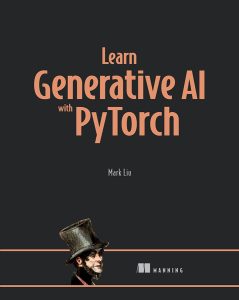
Learn Generative AI with PyTorch by Mark Liu The world of artificial intelligence is evolving at a rapid pace. One book stands out as a beacon for those aspiring to delve into the transformative field of generative AI using one of the most dynamic frameworks available: PyTorch. Learn Generative AI with PyTorch by Mark Liu is not merely a book; it’s a comprehensive journey into the heart of generative artificial intelligence. Mark Liu, with his profound expertise and enthusiasm for generative AI, has crafted a manual that is set to redefine the way we approach AI learning and development. Following Richard Feynman’s philosophy—”What I cannot create, I do not understand”—Liu emphasizes hands-on learning, making this book an indispensable tool for anyone serious about mastering generative AI. Whether you are a student, a professional, or simply an AI enthusiast, this book is your gateway to becoming a part of the generative AI revolution. Join Mark Liu on this remarkable journey and transform your understanding and capabilities in the field of artificial intelligence. |
Embarking on the journey of Generative AI with PyTorch opens a universe of possibilities, from crafting lifelike images to generating text that rivals human writers. The landscape of artificial intelligence is evolving, and with it, the tools and techniques at our disposal.
The key lessons highlighted below serve as a beacon for developers navigating the exciting realm of Generative AI. To dive deeper into each of these lessons and fully harness the potential of Generative AI, we encourage you to explore the comprehensive pages of Mark Liu’s guide, Learn Generative AI with PyTorch.
Key Lessons in Unlocking Creativity with Code
Tensor Manipulation and Data Preparation
Before diving into model development, familiarize yourself with PyTorch tensors—PyTorch’s core data structure. Learn to create, index, slice, and perform operations on tensors. For any data type (images, text, etc.), converting them into tensor format is your first step. Practice with examples like calculating the average height from a dataset or preparing image data by normalizing pixel values.
Building and Training Deep Neural Networks
Utilize PyTorch to construct deep neural networks for various tasks, starting from simple binary and multi-category classifications. Understand the process of defining a network architecture using `torch.nn`, selecting appropriate loss functions (e.g., cross-entropy for classification), and optimizing model parameters with optimizers like Adam. Implement training loops, making forward passes, computing loss, and performing backpropagation.
Generative Adversarial Networks (GANs)
Dive into GANs for generating synthetic data that mimics real-world distributions. Master the architecture of GANs, comprising a generator and a discriminator, and learn the dynamics of training these networks in PyTorch. Explore practical GAN applications, like generating anime faces or modifying image attributes, to understand the versatility and power of generative models.
Utilizing Pre-Trained Models and Transfer Learning
While building models from scratch is invaluable, leveraging pre-trained models can significantly speed up development and enhance model performance. Get hands-on experience with applying transfer learning techniques in PyTorch, fine-tuning pre-trained models for your specific tasks, and understanding how to adjust model layers and training parameters for optimal results.
Experimentation with Transformers for Text Generation
Transformers have revolutionized NLP and beyond with their ability to handle sequence-to-sequence tasks efficiently. Build a basic Transformer model to grasp the self-attention mechanism, learning how it enables the model to capture long-range dependencies in data. Experiment with text generation, translating tasks, or even creating your text-to-image models to witness the power of Transformers firsthand.
Engaging with the PyTorch Community
The PyTorch community is a treasure trove of knowledge, resources, and collaboration opportunities. Actively participate in forums, explore open-source projects, and contribute to the ecosystem. This engagement will not only enhance your understanding and skills but also keep you updated on the latest trends, tools, and best practices in generative AI development.
These key lessons, distilled directly from the content of Learn Generative AI with PyTorch, provide a solid foundation for developers eager to explore and excel in the field of generative AI using PyTorch. By focusing on these areas, developers can immediately start applying these concepts to their projects, leading to more robust, creative, and efficient AI solutions.
Join our Newsletter to stay up-to-date on new releases and special sales!
Wrapping Up
The world of Generative AI is rich with potential, offering the tools to not only reimagine the future but to actively shape it. Through PyTorch, developers gain access to a dynamic and powerful framework that simplifies the complexities of AI development, making the creation of advanced generative models more accessible than ever. The key lessons we’ve shared are merely the starting point; the true depth and breadth of what’s possible lie in the continuous exploration and application of these concepts.
Frequently Asked Questions (FAQs) on Generative AI with PyTorch
-
What is Generative AI?

Generative AI refers to artificial intelligence techniques that can generate new data instances resembling training data. This includes creating text, images, music, and more, that are not duplicates of existing examples but share similar characteristics.
-
Why is PyTorch preferred for Generative AI development?

PyTorch is favored due to its dynamic computational graph that facilitates easy debugging and quick experimentation, crucial for the iterative process of developing and tuning generative models. Its intuitive syntax and strong GPU acceleration also make it ideal for this field.
-
What are Generative Adversarial Networks (GANs)?

GANs are a class of AI algorithms used in generative AI, consisting of two networks: a generator that creates data and a discriminator that evaluates its authenticity. Through their interaction, GANs learn to produce highly realistic data.
-
Can PyTorch be used for text generation? How?

Yes, PyTorch can be used for text generation, primarily through models like RNNs (Recurrent Neural Networks) and Transformers. These models learn patterns in text data to generate new text sequences that mimic the style and content of their training data.
-
What is the significance of Transformers in Generative AI?

Transformers are crucial for handling sequence-to-sequence tasks in Generative AI, such as text generation, due to their self-attention mechanism. This allows them to capture long-range dependencies in data, making them highly effective for generating coherent and contextually relevant text.
-
How does PyTorch facilitate model training and experimentation in Generative AI?

PyTorch offers comprehensive libraries and tools that streamline the development, training, and evaluation of generative models. Its dynamic nature allows for on-the-fly adjustments to models, making it easier to experiment with different architectures and parameters.
-
What are some practical applications of Generative AI models developed with PyTorch?

Generative AI models in PyTorch are used in various domains, including but not limited to, generating realistic images for art and design, creating synthetic datasets for training other AI models, developing advanced chatbots, and composing music or writing creative content.
-
How do developers handle data types and tensor operations in PyTorch for Generative AI models?

PyTorch provides a robust framework for handling different data types through tensors, its fundamental data structure. Developers can perform various tensor operations, such as reshaping, slicing, and mathematical operations, essential for preprocessing input data and designing generative models.
-
How can developers stay updated with the latest trends and advancements in Generative AI using PyTorch?

Developers can stay updated by following official PyTorch and related generative AI project repositories on GitHub, participating in PyTorch community forums, attending conferences and workshops, and keeping up with research publications in the field.