
|
|
From Creating Intelligent Products by Janna Lipenkova In the fast-evolving landscape of technology, artificial intelligence (AI) has emerged as a game-changer, revolutionizing how we conceptualize, develop, and use products. “Creating Intelligent Products” is not just a book; it’s a compass guiding innovators, product managers, and business leaders through the intricate maze of integrating AI into products. From the rudimentary stages of understanding the role of AI in product enhancement to mastering the complexities of AI-driven features and navigating the vast expanse of the modern AI landscape, this book serves as a critical resource. With AI at the heart of technological evolution, now is the time to harness its potential and transform your ideas into intelligent, innovative products. |
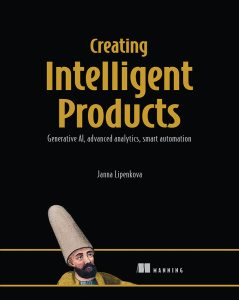
Out Now @ Manning.com!
Who is this book for?
Creating Intelligent Products is tailored for visionaries eager to lead the AI revolution in product development. It’s an indispensable guide for:
- Product Managers & UX Designers: Those at the helm of product innovation will find invaluable insights into incorporating AI seamlessly into product design, ensuring that technology serves genuine user needs and elevates the overall product experience.
- Startup Founders & Entrepreneurs: As the architects of tomorrow’s market trends, startup leaders will discover strategies to harness AI effectively, turning cutting-edge technology into competitive advantages and market-disrupting products.
- AI Enthusiasts & Innovators: Individuals passionate about the intersection of AI and product development will gain a profound understanding of the AI landscape, learning to discern viable opportunities and integrate AI thoughtfully and strategically into their projects.
Unlocking the Potential of AI in Products
Here’s a sneak peek into the key lessons from the book, each offering a deep dive into the core aspects of integrating AI into product development.
Assess the Role of AI in Your Product: Determine whether AI is the central component of your product, an enhancement to existing features, or a tool for internal improvement. This understanding is critical for formulating your product strategy, estimating resources, and ensuring the feasibility of your AI integration. For instance, integrating pre-trained Large Language Models can extend the value of products like Notion and Miro, transforming them into innovative AI-powered services.
Understand the Nature of Your Learning Problem: AI, at its core, is about learning. Define your learning problem by understanding the inputs and expected outcomes. Ensure that the inputs contain appropriate learning signals that allow the model to generalize to new examples. For example, in sentiment analysis, words like “enjoyed” or “fantastic” can be strong indicators of positive sentiment and serve as learning signals for the model.
Navigate the “Build-or-Buy” Decision: Decide whether to develop AI expertise internally or to leverage existing APIs and services. This decision impacts your development effort, your control over the AI capabilities, and the uniqueness of the AI functionalities in your product.
Master Your Data Strategy: Data is the foundation of any AI system. Whether you’re using an existing dataset, annotating data manually, or employing data augmentation techniques, ensure that your dataset accurately represents the problem domain and provides the right learning signals for your model.
Explore Different AI Approaches: Depending on your problem’s complexity and specificity, you might opt for rule-based systems, train a statistical machine learning model from scratch, fine-tune a pre-trained model, or prompt an existing model. Each approach has its merits and is suitable for different scenarios.
Prioritize Testing and Evaluation: Rigorously test and evaluate your AI system to ensure its performance is reliable and to understand the return on investment (ROI) of your optimizations. Employ metrics like precision and recall to measure the accuracy of your model and make informed decisions about balancing different aspects of model performance.
Focus on the User Experience: Design the user interface of your AI product thoughtfully. Onboard and educate your users, maintain an appropriate level of AI awareness, build trust, and give users both perceived and actual control. The user interface should clearly show the distribution of labor between human and AI, highlight potential errors, and allow for iterative improvements based on user feedback.
These key lessons are expanded upon in the book, providing a comprehensive guide for integrating AI into products effectively and strategically. The book delves deeper into each aspect, offering insights, methodologies, and best practices for those looking to harness the power of AI in their product development journey.
Creating Intelligent Products is more than a book; it’s your partner in navigating the AI revolution in product development. It equips you with the knowledge, insights, and practical strategies to transform your visionary ideas into intelligent, market-leading products.
Whether you’re a product manager, a startup founder, or an AI enthusiast, this book is your roadmap to mastering the art of integrating AI into your products, ensuring they not only meet the market demands but also shape the future of innovation.
Embrace the journey, unlock the full potential of AI, and create products that stand at the forefront of technology and user experience. Your adventure in AI-driven product innovation starts here. Grab your copy of Creating Intelligent Products and turn your vision into reality!