

|
|
Transformers in Action by Nicole Koenigstein In the rapidly evolving landscape of machine learning, few concepts have captured the imagination and attention of researchers and developers as much as transformers. Since their introduction at the 31st Conference on Neural Information Processing Systems (NIPS) in 2017, transformers have revolutionized the field of Natural Language Processing (NLP). These powerful models have reshaped the way we approach language understanding, generation, and translation tasks. Enter Transformers in Action, your guide into the fundamental concepts of transformers, exploring what makes them so unique and essential for modern NLP applications. |
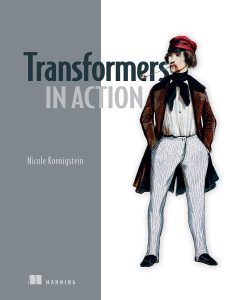
Out Now! Only at Manning.com
Who is This Book For?
Transformers in Action is aimed at those interested in delving into the world of transformers, whether you’re a machine learning enthusiast, a developer eager to harness the power of transformers for NLP projects, or a seasoned data scientist looking to expand your understanding of cutting-edge models. If you’re curious about how transformers work and want to gain insights into their architecture, applications, and limitations, our guide will provide you with a solid foundation.
Let’s take a look at a small sampling of the kind of content you’ll find within.
The Power of Transformers
Understanding the Transformer Breakthrough:
Transformers emerged in recent years as a groundbreaking shift in NLP architecture. Before their inception, models like Long Short-Term Memory (LSTM) were the go-to choice for processing sequential data, including language. LSTM models process sequences element by element, maintaining a form of memory about processed information. However, they struggle with long sequences and fail to capture complex interrelationships between words. Transformers introduced a novel “attention mechanism” that enabled concurrent processing of the entire sequence, allowing them to efficiently capture long-term dependencies. This architectural transformation was a pivotal moment in NLP, enabling faster training and improved performance.
Unveiling Multi-Head Attention:
Central to the transformer’s success is its “multi-head attention” mechanism. Unlike traditional models, transformers can focus on different parts of the input simultaneously, allowing them to capture various aspects of the data. This capability significantly enhances the model’s understanding of intricate patterns and relationships within the input. Multi-head attention empowers transformers to identify nuanced dependencies, making them superior in handling complex tasks such as sentiment analysis. The transformer’s ability to handle diverse relationships contributes to its rapid success and adoption in the NLP domain.
How to Use Transformers: A Practical Approach
Starting your journey with Transformers is made accessible through platforms like Hugging Face’s Transformers library. This library provides a treasure trove of pre-trained models, trained on extensive datasets to capture language nuances. Leveraging pre-trained models eliminates the need to start from scratch, saving time and resources. While transformers can be computationally intensive, the availability of GPUs and cloud services makes them accessible to a broader audience. With Hugging Face’s Transformers library, harnessing the power of transformers for NLP tasks becomes feasible and efficient.
When and Why to Use Transformers:
Transformers have transcended the realm of NLP, showing promise in diverse domains like computer vision and audio recognition. Their accessibility and pre-trained models have driven their rapid adoption in the machine-learning community. Advanced techniques like zero-shot and few-shot learning further broaden transformers’ applicability, allowing them to handle tasks they weren’t specifically trained for. However, these powerful models come with limitations, especially regarding deployment in specialized domains and resource-intensive contexts. As we navigate this landscape, understanding the balance between complexity and practicality is crucial.
Join Our Newsletter for Up-to-Date Notice of New Releases and Deals of the Day!
Transformers have undoubtedly transformed the field of Natural Language Processing. Their attention mechanisms and multi-head attention architecture have propelled them into the limelight, enabling faster training, improved performance, and broader applicability. Whether you’re a novice or an expert, grasping the core concepts of transformers is essential for staying at the forefront of the machine learning landscape. As you embark on your journey into the world of transformers, remember that understanding the foundational principles is the first step towards harnessing their immense potential in shaping the future of NLP and beyond.
And our guide, Transformers in Action, is here to take you along that path.